
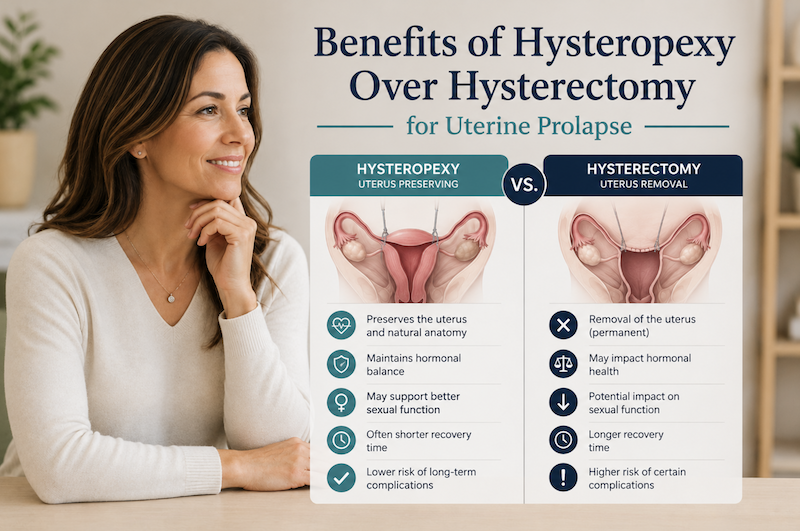
Benefits of Hysteropexy Over Hysterectomy for Uterine Prolapse
Expert Insight from Dr. John Miklos and Dr. Robert Moore
Understanding Your Surgical Options
When treating uterine prolapse, patients are typically offered two primary surgical approaches:
- Hysteropexy → Lifts and supports the uterus (uterus preserved)
- Hysterectomy with prolapse repair → Removes the uterus and reconstructs pelvic support
Both procedures can be effective—but for many women, hysteropexy offers meaningful advantages in function, recovery, and quality of life.
- Preservation of Natural Anatomy
Hysteropexy maintains the uterus and its supporting structures, which helps:
- Preserve natural pelvic anatomy
- Maintain vaginal length and axis
- Reduce disruption to surrounding tissues
This often translates into more physiologic, long-term pelvic support.
- Potential Advantages for Sexual Function
For many patients, sexual health is a key consideration.
Hysteropexy may help:
- Maintain a more natural cervical position
- Preserve vaginal depth and structure
- Reduce risk of changes that can affect sensation or comfort
Patients experiencing deep dyspareunia (pain with intercourse) due to prolapse often benefit when the uterus is repositioned rather than removed.
- Less Invasive in Many Cases
Modern hysteropexy techniques are often:
- Minimally invasive (laparoscopic or robotic)
- Associated with less tissue dissection
- Performed with smaller incisions
- No mesh placed on the vaginal tissue
This can lead to:
- Less postoperative pain
- Faster early recovery
- Shorter hospital stays
- Lower Risk of Certain Surgical Complications
By avoiding uterine removal, hysteropexy can or may reduce:
- Bleeding risks associated with hysterectomy
- Other organ injury
- Operative complexity in some cases
- Disruption to surrounding pelvic structures
- The risk of vaginal shortening
While both surgeries are safe in expert hands, less surgical disruption can mean fewer risks.
- Maintains Pelvic Floor Integrity
The uterus plays a role in overall pelvic support.
Preserving it helps:
- Maintain ligamentous support systems
- Reduce the need for extensive reconstruction
- Support long-term pelvic floor function
- Comparable Long-Term Success Rates
Advanced hysteropexy procedures—particularly Sacro hysteropexy or sacrocolpohysteropexy—have demonstrated:
- High success rates
- Durable long-term outcomes
- Results comparable to hysterectomy-based repairs
The most important factor is surgeon experience and technique.
- Psychological and Personal Benefits
For many women, keeping the uterus is important for:
- Body integrity
- Personal identity
- Emotional well-being
Even when childbearing is complete, uterine preservation can still carry significant value.
When Hysterectomy May Still Be Recommended
Hysterectomy may be the better option if there is:
- Abnormal uterine bleeding
- Large fibroids
- Suspicion of cancer
- Other uterine pathology
A personalized evaluation is essential to determine the safest approach.
Insurance Coverage: What Patients Should Know
A major advantage of prolapse surgery—whether hysteropexy or hysterectomy—is that it is typically considered medically necessary, not cosmetic.
Insurance will usually cover treatment when symptoms include:
- Pelvic pressure or vaginal bulge
- Urinary or bowel dysfunction
- Pain during intercourse
- Functional limitations in daily life
At Miklos and Moore Urogynecology, patients are guided through:
- Insurance verification
- Documentation of medical necessity
- Understanding out-of-pocket costs
- Available financing options
Key point: Treatment for prolapse is reconstructive pelvic surgery, and in many cases, insurance benefits apply.
Why Experience Matters: The Miklos & Moore Difference
Choosing between hysteropexy and hysterectomy is not just about the procedure—it’s about who performs it.
At Miklos and Moore Urogynecology:
Extensive Surgical Experience
- 60+ years of combined experience in pelvic reconstruction
- Over 2000 laparoscopic hysteropexies
- Over 5000 laparoscopic paravaginal repairs
- Over 1500 laparoscopic Burch urethropexies
- Over 3000 laparoscopic Sacro colpopexies
- + advanced laparoscopic prolapse procedures performed
- Expertise in both uterine-preserving and hysterectomy-based techniques
Leaders in Advanced Urogynecology
- Internationally recognized for complex pelvic floor reconstruction
- Specialists in minimally invasive hysteropexy techniques
- Known for treating recurrent and complex prolapse cases
A Destination Practice
- Patients travel from across the United States and internationally
- Frequently sought for second and third opinions
- Focus on restoring both function and quality of life
Why a Second Opinion Matters
If you’ve been told you need a hysterectomy for prolapse, it is not uncommon—and often advisable—to seek a second opinion, especially from a specialist in advanced pelvic reconstruction.
Why?
Many patients are initially told:
- “The uterus must be removed”
- “Hysterectomy is the only option”
However, this is not always the case.
In reality:
- Uterine-preserving options like hysteropexy may be appropriate
- Surgical recommendations can vary significantly based on training and experience
- Not all surgeons are equally experienced in advanced minimally invasive hysteropexy techniques
What a Second Opinion Can Provide
A specialized second opinion at Miklos and Moore Urogynecology can help:
- Confirm whether hysterectomy is truly necessary
- Determine if you are a candidate for uterine preservation
- Identify the best surgical approach for your anatomy and goals
- Address concerns related to sexual function, recovery, and long-term outcomes
Especially Important If You:
- Want to preserve your uterus
- Have been diagnosed with complex or recurrent prolapse
- Are experiencing pain during intercourse
- Have been told surgery is your only option—but want to explore alternatives
An Empowered Decision
Pelvic floor surgery is not one-size-fits-all.
The best outcomes come from:
- Accurate diagnosis
- Multiple perspectives when needed
- Choosing a surgeon with advanced expertise in all available options
- Choosing a surgeon who listens to you and your desires surgically
A second opinion is not about questioning your doctor—it’s about ensuring you have complete clarity and confidence in your decision.
The Bottom Line
- Hysteropexy preserves the uterus and restores natural anatomy
- It may offer advantages in sexual function, recovery, and pelvic support
- Outcomes can be comparable to hysterectomy in experienced hands
- Most prolapse surgeries are covered by insurance when medically necessary
- Surgeon expertise—and getting the right opinion—can significantly impact your outcome
Considering Your Options?
If you’ve been advised to undergo hysterectomy for prolapse, exploring a uterine-preserving option like hysteropexy may be worthwhile.
A specialized consultation—and when appropriate, a second opinion—can help you make a fully informed decision aligned with your body and your goals.