
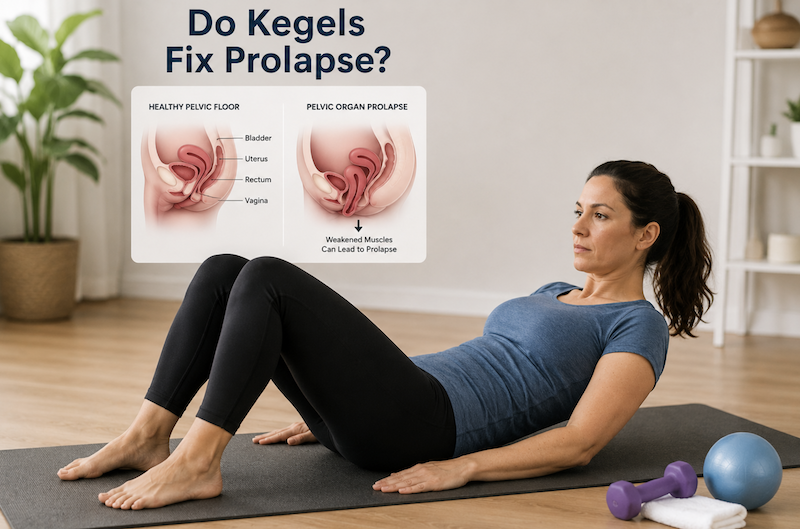
Do Kegels Fix Prolapse? What They Can—and Cannot—Do
Pelvic organ prolapse is one of the most common pelvic floor conditions affecting women—yet one of the most misunderstood when it comes to treatment.
If you’ve been told to “just do Kegels,” you’re not alone. Many women are advised to strengthen their pelvic floor muscles as a first-line approach. But this leads to a critical question:
Can Kegels actually fix prolapse—or are they just delaying the right treatment?
The answer is nuanced, and understanding it can help you avoid frustration, wasted time, and persistent symptoms.
What Are Kegels?
Kegel exercises involve repeatedly contracting and relaxing the pelvic floor muscles, which support the bladder, uterus, and rectum.
These muscles act like a supportive sling at the base of the pelvis. Strengthening them can improve certain pelvic floor functions.
How Kegels Work:
- Contract the muscles used to stop urine flow
- Hold for a few seconds
- Relax and repeat
When performed correctly and consistently, they can:
- Improve muscle tone
- Increase support in mild cases
- Help with urinary control
What Kegels Can Actually Do
Kegels are beneficial—but within limits.
✅ They Can Help With:
- Mild (Early-Stage) Prolapse
In early prolapse, organs have only slightly shifted. Strengthening the surrounding muscles may:
- Improve support
- Reduce symptoms
- Slow progression
- Urinary Incontinence
Kegels are highly effective for:
- Stress incontinence
- Leakage with coughing, sneezing, or exercise
- Postpartum Recovery
After childbirth, Kegels can:
- Restore muscle tone
- Improve control
- Support healing
What Kegels Cannot Do
This is where many patients are misled.
❌ Kegels Do NOT:
- Lift organs back into place once they have significantly descended
- Repair stretched or damaged ligaments, fascia, collagen
- Reverse moderate or advanced prolapse
- Eliminate a visible or palpable bulge
This is because prolapse is not just a muscle problem—it’s a structural support failure.
Why Kegels Don’t “Fix” Prolapse
Pelvic organ prolapse involves:
- Weakening of ligaments and supportive tissue known as fascia
- Weakening and laxity of pelvic floor musclees
- Stretching of connective tissue
- Loss of structural support
Even if muscles are strengthened:
They cannot fully compensate for damaged support structures.
Think of it like:
- Tightening a net under a sagging structure
- Helpful—but not enough to lift it back completely
When Kegels Are Most Effective
Kegels are most useful when:
- Prolapse is mild (Stage 1)
- Symptoms are minimal
- There is no visible bulge
- The goal is prevention or stabilization
When Kegels Are Not Enough
You are unlikely to see meaningful improvement with Kegels alone if you have:
- A visible or palpable bulge
- Symptoms that worsen throughout the day
- Pressure or heaviness
- Pain during intercourse
- Urinary or bowel dysfunction is severe enough that it affects your quality of life
These are signs of moderate to advanced prolapse
The Biggest Mistake Patients Make
One of the most common—and costly—mistakes is:
Relying on Kegels for too long while symptoms worsen
This can lead to:
- Progression of prolapse
- Increased discomfort
- More complex treatment later
Are You Doing Kegels Correctly?
Surprisingly, many patients are not.
Common issues:
- Using the wrong muscles
- Bearing down instead of lifting
- Inconsistent practice
This is why guided pelvic floor therapy is often more effective than doing exercises alone.
Pelvic Floor Therapy vs Kegels Alone
Pelvic floor physical therapy includes:
- Biofeedback
- Guided muscle training
- Functional strengthening
- Breathing coordination
This provides significantly better results than unsupervised Kegels.
Can Kegels Prevent Prolapse?
They may help:
- Reduce risk
- Delay progression
But they cannot fully prevent prolapse, especially when factors like:
- Childbirth
- Genetics
- Aging
are involved. In theory Kegels are probably best performed prior to ever getting pregnant.
What Actually Fixes Prolapse?
Treatment depends on severity:
Mild Cases
- Pelvic floor therapy
- Kegels
- Lifestyle adjustments
Moderate to Severe Cases
- Pessary
- Surgical repair
When to Seek Evaluation
You should not rely on Kegels alone if you have:
- A bulge
- Persistent pressure
- Pain during intercourse
- Worsening symptoms
- When the symptoms disrupt your quality of life
Why Specialist Evaluation Matters
Accurate diagnosis is essential.
Specialists like Miklos and Moore Urogynecology focus on:
- Identifying severity and type
- Determining appropriate treatment
- Avoiding unnecessary delays
Final Takeaway
Kegels are helpful—but they are not a cure for prolapse.
👉 They strengthen the pelvic floor muscles
👉 They may help early symptoms
👉 But they do not fix structural descent due to compromised fascia and ligaments
Understanding this distinction is key to getting the right care.